Showing posts with label Exploit. Show all posts

Saturday, September 22, 2012

ZeroAccess: 9 million infected, are you one of them?

    As I mentioned in my previous post, ZeroAccess is still around and is adapting. Over 9 million PCs are now infected with this bot. Most are located in the USA or Western Europe. 33% of super nodes are located in Germany, with the US coming in a close second with 32%. A super node is an infected machine that is not behind a system like NAT so that other bots, or peers, can access it. This post will be mainly directed at how to tell if you are infected, and who is at the most risk of infection.

    ZeroAccess uses multiple install locations, so you should check all of them. The main component drops at two locations, 1 in appdata, the other in windows/installer. if one is deleted, the other is still perfectly capable of functioning. The two locations are shown in figure 1.1.
Figure 1.1
Thanks to SophosLabs
 Both contain a dll file, named "n" (the main component), which are added to startup by hijacking a COM directive. These also contain a file named "@" which is a list of predetermined peers for the bot to connect to and retrieve updates, commands, etc. These folders also have 2 directories named "U" and "L" which contain plugins and temp files.


Also, if you have windows vista or up, ZeroAccess will try to patch services.exe fortunately, it is easy to restore by running the following command:
sfc.exe /scanfile=c:\windows\system32\services.exe
Simply check for these signs to see if you are infected. If you have been browsing the web without appying recent updates to internet explorer, adobe flash, or java, scan and fix, and apply all updates.
My next post will explain in detail how to remove and protect from this virus.

Credits:
SophosLabs


Monday, September 17, 2012

New IE Zero day (what a surprise)

    Well, yet another exploit for the shoddy excuse of a browser known as Internet Explorer has been found. This exploit works with IE 7, 8, and 9. It works by dropping a malicious SWF file, which then drops a Trojan R.A.T. (Remote Administration Tool) known as "Poison Ivy". Microsoft has not yet commented on the matter, but is probably preparing a security advisory.

    The Exploit is detected by most Anti virus software, so make sure to firewall up. The threat has been linked to the same hacker group responsible for the Java zero day released late last month. Both are now available for free on Rapid7's Metasploit framework. Rapid7 reasercher "sinn3r" wrote
“Since Microsoft has not released a patch for this vulnerability yet, Internet users are strongly advised to switch to other browsers, such as Chrome or Firefox, until a security update becomes available. The exploit had already been used by malicious attackers in the wild before it was published in Metasploit. The associated vulnerability puts about 41% of Internet users in North America and 32% world-wide at risk.” 
I highly suggest you IE users dump your current browser and pick up chrome.
Be sure to comment with ideas for next post, and keep an eye out for my upcoming google+ and facebook pages.

Update:
Microsoft releases fix for the zero day and a number of other flaws. They also fixed a flaw with adobe libraries that were used by IE.
This update is applied automatically if you have automatic update enabled or you can run windows update.

Credits
krebs
Trend Labs


Tuesday, May 29, 2012

ZeroAccess Part 2: What does it do?

First off, sorry this took so long. It is finals week so I have been quite busy.

Overview


ZeroAccess will install 2 different versions of itself depending on the system architecture (32 or 64 bit). Once it has dropped the correct version, and elevated it's privileges, it starts talking with other infected machines to get  instructions. Most of the time, it is used to "Sell Installs". That is, other "hackers" can pay someone to install their virus onto the already infected machines. One of the most popular viruses that is installed with ZeroAccess is Zeus (see Zeus Continues to Evolve and New Variant of Zeus includes Ransomeware). Once that is installed, the "hacker" can steal your personal data including, but not limited to, your credit card number, login credentials to different sites (including banking sites) etc.

Installation
  • 32 bit
    • When file dropper is executed, it checks whether it is on a 32 or 64 bit computer, then installs the corresponding kit. If it is on a 32 bit machine, it drops a kernel mode or Ring-0 rootkit. It drops itself into a hidden folder. It adds itself to startup, and checks it's list of predetermined C&C (Command and Controls). it then attempts to connect to them on TCP port 13620 and awaits commands.
  • 64 bit
    • The 64 bit version of ZeroAccess does not have a Ring-0 rootkit. It does, however, have a Ring-3 or User-mode kit. When initiated, it attempts to raise it's privileges as described in part 1. Once that is done it protects its process (makes it harder to kill) and waits for commands.
Communication

The virus comes with a list of known IPs of infected machines. If these machines have UPNP enabled and the ports are properly opened, they become server nodes. If not, then they are just clients. Once it has succesfully made a connection, it is added to the other bots list, and updates its own list. It then periodically checks in with the other servers to see if any new commands were issued. The bot uses TCP port 13620 to connect to others. All communication is encrypted with RC4 encryption. 

Monetizing

The virus is most commonly used to install other viruses like Zeus. It also downloads a click fraud virus. This virus is almost always seen with ZeroAccess, so it is thought that it may be authored by the creator of ZeroAccess. And finally, it downloads a spam bot. This is a virus that is used to send spam, junk, or infected links via e-mail.

Conclusion

This is a very sophisticated piece of malware, and while it may not yet be on par with the TDL family, it is definitely getting there. While it is already dangerous now, imagine what it could become capable in 5 or 10 years from now. As soon it is detected, this must not be ignored. the only way to stop it effectively is to completly remove it from the system. While it is currently only used to download malware to monetize, this could and most likely will change as the owner rents out space and allows other files to be downloaded.


Credits to McAfee labs, Sophos, and PrevX

Friday, May 25, 2012

ZeroAccess Part 1: What is it

ZeroAccess is quickly becoming one of the go to rootkits, and may surpass the TDL family in the coming years. Machines are most commonly infected using 2 techniques, the first being through an exploit kit, the second being Social Engineering.

BlackHole Exploit Pack
Infection Statistics
Let's first take a look at how the exploit kit infection works. First, an Exploit Pack, is a webpage that is designed to exploit software commonly installed on computers, such as Flash, Java, Internet Explorer, etc. It tries to find loopholes to let it silently download and execute a program on the victims computer. Most Exploit Packs use outdated exploits that are already patched, although, a few extremely high-end packs use what are known as "0-Day" exploits. This means that it works for the newest version of exploited software, and is not yet know/detected. To drive traffic to these exploits, "hackers" find holes in legitimate websites, and embed a small code into the pages that will direct the user to their site unknowingly. This is most often done through an "IFrame" set to be 0px wide and 0px high. Since the user does not need to see or interact with the exploit site, this works perfectly. Sometimes a JavaScript is embedded, although this is less common as some web hosts have JavaScript disabled, and it is more noticeable. The exploit then goes through its list of exploits, and, if one is found working, downloads and executes the payload (ZeroAccess).

Figure 1.1
Sometimes, the "hacker" uses Social Engineering techniques to try and get the user to willing download and execute the file. This is usually done by attaching the file to some sort of program crack or keygen. The "hacker" will bind his virus (ZeroAccess) to the crack, and then upload it to a filehost, or torrent host. The user will download and execute this file and, since it works, won't be very suspicious. The "hacker" can also use something called a "Java Drive By". This is more of a mix of exploit and Social Engineering. The "Hacker" sets up a site where there is a browser game or camera that needs Java to run. When the victim goes to the website, he will first be prompted to allow java to run (see Figure 1.1), then he will be asked to download and install an "update". This update, of course, is actually the "hackers" virus. Then, once the user clicks ok, the page will "refresh" and the application that required Java will work. The user, being satisfied that it works, will not suspect a thing.

Figure 1.2
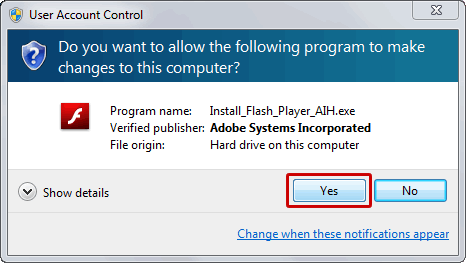
When the virus is executed, it first checks what architecture the computer is (32 or 64). It then drops the related file and dies. Once the file is dropped, if execute on a non-admin account, it will require a UAC popup window . It does this by acting as if it is an official adobe update. It replaces a .dll inside of the adobe installer folder, and prompts the user to download the update (see Figure 1.2). This "update" actually downloads the latest flash player, but also gives the virus admin permissions. It then goes on to connect to other infected computers, and await orders.

Stay tuned for Part 2: What does it do
then later, the final part Part 3: How to stop it

Credits to McAfee labs, Sophos, and PrevX